Pacific Union College HomePitcairn Islands Study Center Home
Study Center Bligh & Bounty Pitcairn Island Norfolk Island PUC Library

The Study Center  

Center Resources  

News  

Bligh & Bounty  

Pitcairn Island  

History  
Government  
Education & Religion  
Group of Islands  
Maps of Pitcairn  
Photo Tour  
Philately  
Pitcairn Sea Tales  
Current Population  
Contact Pitcairn  

Encyclopedia  

Pitcairn & PUC  

Norfolk Island  

Study Center Home

Center Store  

Pitcairn Crafts  

Contact Us  

Site Map  


Education on Pitcairn

The story of education on Pitcairn Island begins at the turn of the nineteenth century when the well-educated Edward Young taught John Adams to read from a Bible and a Prayer Book, which had been salvaged from HMS Bounty. After Young’s death in 1800, John Adams taught the first generation of children to read. Then in 1823, John Buffett arrived at Pitcairn on a British whaler, the Cyrus, and took over the role of teacher. In 1828, George Hunn Nobbs arrived at Pitcairn and assumed the triple role of pastor, surgeon and teacher, first on Pitcairn and later on Norfolk Island.
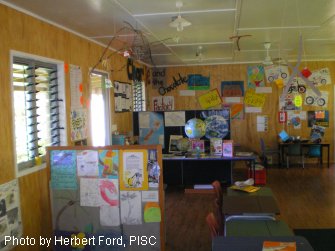
Pitcairn Island SchoolAfter the Pitcairners’ return from Norfolk Island in 1864, Simon Young, a descendant of one of the mutineers, and his daughter Rosalind kept a simple system of education alive until, in the last decade of the century, the school came under the guidance of the Seventh-day Adventist Church. Between 1917 and 1938, when the Church again appointed a resident pastor, the academic side of the school was once again left to the islanders. In 1958 Government formally assumed responsibility. Legislation first introduced in 1838 provides for the compulsory attendance of children between the ages of 5 and 15 and for a minimum five-hour day of 380 half-days a year.
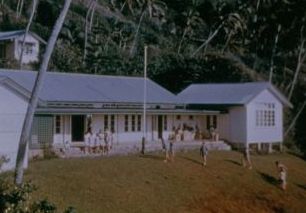
Pitcairn Island studentsToday, the Education Officer is appointed by the Government from suitable qualified applicants who are New Zealand registered teachers. The Education Officer is also the Government Adviser and Editor of Miscellany, the island newspaper, and is contracted for two year terms. The Education Officer is assisted by a Pitcairn language teacher and staff include a cleaner and grounds person.

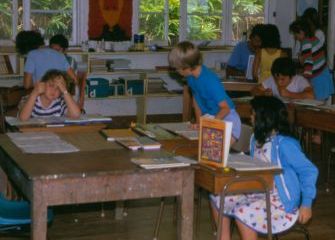
The school and the teacher’s residence have recently (2004) been reconstructed with the first buildings having been completed in 1950. The equipment is modern and includes a 7.5 kva generator, a film projector, piano, sound system, computers, television, VCR, photocopier and a range of woodwork tools. The school library is kept well stocked.

The average attendance at the school in the early 1950s was 20 pupils, increasing to 28 in 1959 and 36 in 1962. Since then the roll has gradually decreased and in 1999 there were 10 pupils.

The school provides primary education, based on the New Zealand syllabus, and correspondence courses in post-primary education were introduced in 1957. Overseas secondary education is encouraged by the grant of bursaries and a number of students have received secondary education in New Zealand at Pitcairn Government expense.

The pattern of education on Pitcairn keeps pace with curriculum changes in New Zealand. The island, traditionally a land of smallholders and handicraft traders, has developed new markets for the export of dried fruit and honey products. Tourism is developing into a more significant local industry both with visits by cruise ships and with those who visit to stay a few weeks on the island.

Education policy therefore aims to provide a broad range of skills to enable adaptability in a changing environment.

Religion on Pitcairn Island

by Herbert Ford, Director
Pitcairn Islands Study Center

We know there was religious practice on Pitcairn long before the coming of the Bounty sailors and their companions in the late 1700s. We don’t know much of anything about the type of religious practice of pre-mutineer times, unless we can presume that it closely followed that of the Polynesians to the north and west of Pitcairn, or perhaps even some of the people from the east. However there was much evidence found on the island in earlier years of religious artifacts and implements. Unfortunately most of it has been destroyed or otherwise lost.

Once Fletcher Christian and his companions began their occupation of Pitcairn religion seemed to play only a small and insignificant role in their lives. But, again, unfortunately, little is recorded for us about the first two decades of Pitcairn life after the occupation by the mutineers. It was not until the rather strange and marvelous life change that came to John Adams that religion seems to have become a significant part of Pitcairn life. Once he had decided that religion held the promise of a better life for the little colony on the island, Adams lost no time in implementing what we would call strict religious practice.

Sir Charles Lucas, editor of The Pitcairn Island Register Book, describes the coming of religion to John Adams’ life well in his introduction to the book:

“Many notable cases of religious conversion have been recorded in the history of Christianity,” writes Sir Lucas, “but it would be difficult to find an exact parallel to that of John Adams. Portrait of John Adams

“The facts are quite clear. There is no question as to what he was and did after all his shipmates on the island had perished. He had no human guide or counselor to turn him into the way of righteousness and to make him feel and shoulder responsibility for bringing up a group of boys and girls in the fear of God.

“He had a Bible and a Prayer Book to be the instruments of his endeavour, so far as education, or rather lack of education, served him. He may well have recalled to mind memories of his own childhood, But there can be only one simple and straightforward explanation of what took place, that it was the handiwork of the Almighty, whereby a sailor seasoned to crime came to himself in a far country and learnt and taught others to follow Christ.”

And earlier in his introduction, Sir Lucas puts the unusual-ness of the whole matter in almost dramatic perspective:

“In order to fully appreciate the Pitcairn story,” he writes, “it is necessary to keep before the mind’s eye the contrasts which it presented. What could be more remote from the murders and crimes of the early years upon the island than the settlement as it developed under John Adams, in peace, godliness and comparative innocense.

“Or, again, contrast the day-to-day life of this tiny, isolated group of human beings, as it flowed on in even monotony, with the wars and rumours of wars and great events which in the same years stirred the whole outside world. Pitcairn might have been on another planet!”

So it was that from shortly after the turn of the century until his death in 1829, John Adams was Pitcairn’s strong religious advocate and mentor, as well as its civil leader. Some folk, stretching things a bit I think, have suggested that Adams was pretty much a dictator. There is not a great deal of fact to back up such contention though.

According to the Reverend Thomas Boyles Murray, John Adams observed the rules of the Church of England; always had morning and evening prayers; and taught the children the Collects, the Catechism, and other portions of the Prayer-book. He was particular in hearing the children say the Lord’s Prayer and the Apostles’ Creed. And, it seems Adams was a popular religious teacher too.

Murray writes that Adam’s youthful pupils took such delight in his religious instructions that on one occasion, on his offering to two of the lads - Arthur Quintal and Robert Young - some compensation for their labor in preparing ground for planting yams, they proposed that instead of his giving them some gunpowder as a present, that he should teach them some extra lessons from the Bible – a request with which he joyfully complied, says Murray.

Adams early religious background was part and parcel of his work-house upbringing in England where he would have undoubtedly been exposed to some of the rites and ceremonies of the Church of England. Relying on these childhood memories, it is understandable that at times his recollection or understanding faltered, or that he tended to extremes in biblical exegesis. The church’s injunction to fast on Ash Wednesday and Good Friday was transmuted by Adams on Pitcairn into a prescription of weekly Wednesday and weekly Friday fasts, much to the discomfort of his flock.

The Bounty Bible

Only after the arrival of John Buffett in 1823 was Adams “set straight” on this point about the fasts, but in spite of this he still continued the Friday fasts - every Friday! Adams particular construction on the prohibited degrees in marriage, might well have saved the community from extinction. The table of kindred and affinity in the Book of Common Prayer that spoke to this matter was thankfully often ignored. Nevertheless certain Levitical laws, such as those requiring abstention from unclean birds, were observed.

In these more permissive views of his about marriage between “relatives” to achieve what Adams considered good purpose, he may have inadvertently set the stage for practices on Pitcairn, the unfortunate result of which the Island has even in recent years experienced.

But the piety that Adams instilled in the Pitcairn community was to become legend world-wide. That this should be so is all the more amazing considering that all of the other adults, up to the arrival of Buffett, Evans and Nobbs, were Polynesian. Being in the majority, and also being the mothers of the community, the Polynesian women were in a strategic position to foster the tenets of their own faith on Pitcairn. By the time George Hunn Nobbs arrived though, Christian services had developed to such an extent that “Island visitors wavered between boredom at their length and repetitiousness, and awe of what they were witnessing.

The devout religious attitudes and observances of the Pitcairners – reported to the outside world by captains, crews and passengers of ships calling at the island – set loose a wave of approval so forceful that it only intensified the piety and religiosity of those on the island. Raymond Nobbs says “What was reported from Pitcairn about the Islanders’ piety and faith served as a powerful argument in support of some of the most cherished tenets of both organized religious institutions and believing individuals.”

Here then – on tiny, remote Pitcairn Island – was living, flourishing proof of the efficacy of the Christian ethic and the salvation which lay in the Gospel in religious attitudes and observances: this people all around the world came to believe. And as word came back to the Pitcairners of the admiration the world had for their piety, their reaction was to increase their Christian virtues, asking repeatedly for more religious instruction for the people. These repeated requests of the Pitcairners for a clergyman to teach them the way of righteousness are a matter of record in numerous letters we’ve examined in Honolulu, Sydney, Wellington and London. A few of the sincere calls for spiritual guidance are also on file in the Pitcairn Islands Study Center.

When Captain William Waldegrave, along with his chaplain, arrived at Pitcairn in the Seringapatam in 1830 with supplies for the islanders, this is the reported conversation that took place:

“I have brought you a clergyman,” said Captain Waldegrave.

“God bless you,” issued from every mouth, “but is he come to stay with us?”

“No.”

“You bad man, why not?” from the people.

“I cannot spare him, he is the chaplain of my ship, but I have brought you clothes and other articles, which King George has sent you.”

“But,” said Kitty Quintal, “we want food for our souls!”

In 1840 the London Missionary Society ship Camden, with Captain Morgan in command, called at the island. The Reverend Mr. Heath and the Captain went ashore with presents from the Governor of New South Wales, the Lord Bishops, and the Reverend D. Ross. Mr. Heath preached a most impressive sermon which the Pitcairners listened to with breathless attention. And Captain Morgan spoke to them on “The Care of the Soul.” But after three impressive services during the day and evening the Camden spread her sails, beat to windward, and was lost over the horizon. The ongoing watering of their souls which the Pitcairners so earnestly desired was once again denied them.

There is no doubt that the piety of the Pitcairners was genuine. When the French Consul Morenhout visited the island, his feeling about the Pitcairner’s piety was determined by an episode which took place when he was put to bed in the same room with some of the islanders. After they thought him asleep, the elders woke everybody but the Consul and said their prayers on their knees. Morenhout, who was awake but pretending sleep during the prayers, was deeply impressed.

While their adherence to Christian values remained strong while in their Island home, the move of all on Pitcairn to Tahiti in March of 1831, proved to be the undoing of much that the people had learned of the Christian way. What was seen in Tahiti – and yielded to by some while there – had its unfortunate effect once the Pitcairners returned to their homeland.

“The godly discipline established by Adams had been sadly sapped,” says one writer of the Pitcairners’ short stay in Tahiti. “The ancient still of the Bounty which was used for making alcoholic drink once again appeared and “seethed devilishly.” It had been said that ‘the Pitcairners of those earlier days never really forsook the habits of the Tahitians.” Certainly the demoralizing atmosphere of Papeete began to have an effect once the people had returned to Pitcairn.

And it was in Tahiti that the Pitcairners learned racial prejudice, something they had never thought of before. Among those of lighter skin there came to be a hatred of the Black people.

Into the vacuum after Tahiti came a character to Pitcairn life who was a dictator in the real sense of the word – one Joshua Hill. A recital of his devastation and demoralization of the Pitcairn spirit will serve no good purpose here. He attempted to be both religious and civil leader of the Island, and on the religious side of things, about the only good deed he did was to destroy the old still and thus thwart the often unbridled use of the kickapoo joy juice that was brewed in it.

With Hill’s departure from Pitcairn, George Hunn Nobbs, who had taken on the role of Pitcairn’s pastor, was to become an effective religious leader. In 1850 the Pitcairners began to add harmonious music to their religious services through the teaching of Hugh Carleton, a gifted musician who was one of those stranded on Pitcairn when the bark Noble sailed off and left them.

By 1852, Pastor Nobbs was able to enhance his religious leadership of the Island considerably when through the courtesy of Admiral Fairfax Moresby he was able to go to London and there be ordained as a minister of the Church of England. For four years, thereafter, until the departure of the Pitcairners for Norfolk Island, the values of true religion were again evident in abundance on Pitcairn.

Back on Pitcairn again after their stay on Norfolk Island, the band of those who chose to return continued practicing the Church of England principles they had faithfully followed under the leadership of George Hunn Nobbs. All attended weekly worship services, with Moses Young acting as host. The services were enhanced by Young’s musical solos on the fife and violin, instruments he had learned to master under Hugh Carleton’s direction in 1850.

In 1860, H..M.S. Calypso called at the Island to show the flag of Mother England. The ship’s chaplain came ashore and spent several hours in religious instruction of the children. But Pitcairn had to continue without a religious leader, even though their calls for someone to lead them in Godly ways continued through the 1860s and into the 1870s.

One day in March 1876, the ship St. John, made a call at Pitcairn that was to eventually change the religious persuasion of the Island. Captain David Scribner went ashore, along with “a beautifully-toned Mason and Hamlin Organ which the Pitcairn men shouldered up the Hill of Difficulty to the village. Once in place in the thatch-roofed Island church, the good Captain sat down at the organ and led the Pitcairners in a stirring rendition of the old gospel hymn “Shall We Gather at the River?”

Among the many other gifts Captain Scribner brought onto the Island that March day was a large box of Christian literature - literature printed by those of the Seventh-day Adventist faith. It had been brought to the San Francisco docks and put into Scribner’s hands by two Seventh-day Adventist ministers in California’s Napa Valley, James White and John Loughborough.

After the St. John sailed onward toward Cape Horn and her destination at Liverpool, England, the Pitcairners studied the literature Captain Scribner had brought. They noted that it said the Adventist faith calls for worship on the seventh-day of the week as counseled in the Bible. And they noted that the Adventists believed in the return of Jesus to earth a second time - the Second Advent they called it. The name of their faith - “Seventh-day” and “Adventist” - came from those two important aspects of the Christian faith, the literature said.

But the Picairners were content in their Church of England practice at the time, and the literature was set aside. A decade passed, and then in 1886 Pitcairner Rosalind Young, the daughter of Island leader Simon Young, one day happened upon the literature. She found a tract entitled “The Sufferings of Christ,” and found it of such interest that she encouraged her father to read it. He did and was so interested in what he had read that he encouraged others to read the various tracts.

Alta Hilliard Christensen in her book, “Heirs of Exile,” says of the spread of a new gospel: “At first the Pitcairners read the papers with extreme care and suspicion, as though they were afraid of being entrapped, but when they found that every doctrine presented was given on Biblical authority their fears subsided. The more they studied the more interested they became. . . . Although nearly every one of them felt an inner conviction on the matter, no one had the courage to break away from the established custom and begin the observance of a different day of worship.”

An interesting historical footnote to the idea of the Pitcairners changing their day of worship from Sunday to Saturday, the week’s seventh day, is that from the time the Islanders began their adherence to the principles of the Church of England under John Adams shortly after the 19th Century began and until 1814 when the British warships Briton and Tagus called, they HAD been worshiping on Saturday, even though they thought it was Sunday. The confusion had come when the Bounty crossed the International Date Line coming eastward and the adjustment needed had not been made. Thus the two days were confused until Captain Staines corrected them when the two British ships chanced upon the Island in 1814.

Portrait of John I. Tay And now, in addition to this new reading of Bible principles by most of the Islanders, there came to their rocky shores an American seaman named John I. Tay, who would help solidify their feeling that a change in their worship should happen. Tay, who spent many years at sea on several ships, had more recently retired in Oakland, California. He had become convinced of the value of the Seventh-day Adventist faith, but of late had began languishing in health. On his doctor’s advice that he should move out of the polluted air atmosphere of Oakland, Tay put to sea again in an attempt to regain his health. At the same time he was eager to tell others the principles of the faith he had come to love. Having read the story of the Bounty mutiny and its aftermath, he determined to tell the Pitcairners about his faith. His journey to Pitcairn is an interesting one but time does not permit a recounting of it just now.

Once he arrived at Pitcairn, by permission of the islanders Tay stayed on the island for five weeks in October and November of 1886 studying the Bible with them. By the time he sailed from Pitcairn on the yacht General Evans, the majority of those on the island had decided to become Adventists. They asked Tay to baptize them into the new faith, but he explained that only an ordained clergyman could do that, and he was simply a layman. But he promised to return with an ordained minister.

Two years later Tay attempted to fulfill his promise, but the affair ended in a maritime disaster. Then in 1890 he was able to keep his word with the calling at Pitcairn of the Adventist missionary ship which was appropriately named “Pitcairn.” Almost all of those on the Island chose to be baptized.

A number of the islanders, caught up in the love of their new faith just as John Tay was, decided to carry word of the Adventist faith to other islands of the Pacific Ocean. The missionary ship Pitcairn called first at the island on each of its six voyages into the Pacific from San Francisco, and several times Pitcairn Islanders left the Island on it to carry the Christian gospel elsewhere. Several of the Pitcairners, feeling the need for advanced education, came to the United States on the missionary ship where they studied at Healdsburg College in Northern California, the forerunner school of Pacific Union College where the Pitcairn Islands Study Center is now located.

Through the years of the 20th Century the practice of their Adventist faith brought joy to many Pitcairn hearts and Christian comfort to countless others. The long tradition of the singing of hymns of the Christian faith from their longboats by the Pitcairners at the departing of each ship from the island has been a treasured expression of their faith. It has drawn favorable even passionate comment by hundreds of ship captains, and not a few from passengers and crew members.

Church Service

In her article in the “Eastern Horizon” magazine in 1980, Molly G. Elliott describes the effect of the Pitcairners’ religious faith and their singing of it when she was a passenger on the Mataroa which called at the Island:

“Once alongside the Mataroa, the Pitcairn people swarmed up the ship’s ladders amid bursts of unlaced laughter. Tall, dark, biscuit-skinned, they have perfect teeth, and charming old-world manners. No one wore shoes. Even though, like most New Zealanders, I go barefooted around the home in summer, I had never seen feet like those – gnarled, the toes splayed and almost prehensile.

“They brought aboard palm-leaf kits filled with bananas, oranges, pawpaws, pineapples and carvings of flying fish and tortoises and boxes in the shape of an open Bible. Unlike souvenir traders on other Pacific islands, they did not solicit custom with a beggar’s cajoling whine. Nor did they permit haggling.

“As we had arrived on Saturday, the islanders refused to trade on this, their Sabbath. We could take what we wanted and make a donation. One woman distributed Seventh-day Adventist literature.

“When the ship’s siren boomed an all-ashore signal, the islanders tumbled down the ladders, those extraordinary toes gripping strongly.

“They rowed away to a safe distance and then, their boats rising and dipping on the slow, grey Pacific swells, they sang in perfect unaccompanied harmony, the old hymn ‘Shall we gather at the River?”

“I had seldom heard such moving singing,” Ms. Elliott writes. “Absolutely silent, passengers and seamen clustered along the rail, many with brimming eyes. Then the ship swung away, the women waving as the men bent stoutly to the oars, judging to a whisker the channel between the rocks into Bounty Bay.”

Church celebration

The long-lasting, positive effect of hearing the Pitcairners sing of their Christian faith to passing ships is even more clearly illustrated in terms of lasting positive effect in the book, “A Deepwater Family,” published just a few years ago by Fred Duncan, the son of Captain F. C. Duncan of the three-skysail-yard ship Florence which called at Pitcairn in 1895. At that time Fred Duncan, writer of the book, was just a boy, and now here he is writing well over half a century later about the call of his father’s ship at Pitcairn and of the hymn singing of the Pitcairners:

“Two big longboats rowed out to us and their crews came aboard,” writes Duncan. “As it was late in the afternoon, time was short and trading was brisk In order to avoid the danger of being set too near the shore by the current, the ship was kept under shortened sail, and we started to draw away from the island.

“As twilight began to make its outline in the distance, the island leader came to the cabin to say farewell. Noticing the little cabinet organ, he asked my father if his men could sing to us. They were given an enthusiastic invitation to come in and soon our little room was crowded. Without any introduction they swung vigorously into the familiar hymns of the Moody and Sankey era, roaring out the refrains with a power that held us, and with a Polynesian rhythm that was irresistible.

“They particularly liked a hymn titled ‘God Is Calling Yet:’ ‘God is calling yet, you hear ‘em,’ they roared, and excitement mounted like that at a revival meeting. By the time the final hymn was finished and the last of our friends slid down the line to his boat, a light mist lay low over the water. Moonlight gave the scene unrealistic loveliness, which was heightened as the boats pulled off into the haze by the rhythmic splash of oars, their rattle against thole pins, and the repeated diminuendo choruses of ‘God is Calling Yet’ - ‘God is Calling Yet, you hear ‘m, God is Calling Yet.’

“I was only eight years of age at the time, writes Fred Duncan, now an old man, “but it was a spiritual experience that has lived through a lifetime?”

The commendable and beloved practice of the singing of Christian hymns to passing ships has been somewhat forgotten on Pitcairn Island today. It has been replaced usually only by the singing of the plaintive Pitcairn “Good Bye Song.” In the death of that practice I am afraid that something of great value has died or is dying on Pitcairn Island.

As with all religious persuasions, the Adventist faith has not been an absolute shield against the anti-social or lawless actions of a very few on Pitcairn. The 1897 murder of his wife and child by Pitcairner Harry Albert Christian, an Adventist young man overcome by lust and passion, is but one example of how religion, while it is the power of God unto salvation, is only so to those who place their complete and daily trust in the power of the divine.

Church celebration

In recent years religion of any persuasion has declined on Pitcairn. In mid-2005 fewer than a dozen of the 50 or so people on the island are members of the Adventist faith. A significant number of others espouse no specific religious faith at all. Any assessment of the good or ill the practice of religious faith has had on the Pitcairn people through its two centuries of present habitation is largely in the eye of the assessor.

I believe that the adherence to the biblical principles of both the Church of England and the Seventh-day Adventist faith by those Pitcairners who have been faithful to the heavenly vision has had a decidedly salutary effect on Pitcairn life. Ever since those early years of the 1800s, when John Adams, “a sailor seasoned to crime, came to himself in a far country and learnt and taught others to follow Christ,” Pitcairn Island, the “Rock of the West” has been a better place for it.

#####


© 2003-6 Pacific Union College