--Text
by Mark Winthrop of Copenhagen, Denmark. Used by permission. (http://www.winthrop.dk/chimp.html)Henderson
Island was the site of a modern castaway story in 1957 - one of the marooned seamen
was a chimpanzee! 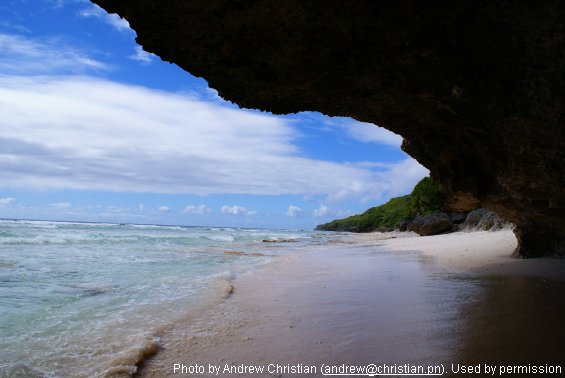 | Reproduction
expressly forbidden except by contact with Andrew Christian at andrew@christian.pn. |
The
Participants In the late 1940's, John Owen Wells, a schoolteacher in
Vancouver, Canada began building a 38' 13-ton auxiliary ketch which he later called
the Flying Walrus. After five years he completed the yacht. It was painted
blue and white and had an auxiliary engine and was equipped with a radio receiver. With
his wife Diane, a school gym instructor and physiotherapist, he began a Pacific
voyage with the goal of reaching Auckland, New Zealand. Here the Wells couple
intended to stay for approximately 1-½ years. After this prolonged stay in Auckland
they planned to continue their cruise around the world. People who had met
Wells and his wife in San Francisco and Tahiti described them as a very level-headed
couple. Wells was reported as being quiet and reserved, with a keen knowledge
of sailing. He was described as a very nice guy. One person who had met
them in Tahiti reported that they were honeymooning. Wells told this person that
he was thinking of "giving away" school teaching and working as a boatbuilder
in Auckland. They were a very nice couple, friendly and interesting
to talk to. Their boat was new when they left Canada and was in excellent condition
when we saw it in Tahiti. It is unlikely they would get lost or become shipwrecked.
They were both very experienced in handling boats.
Mrs. Wells
was described as having delicate features and a very good personality. You
wouldn't describe her as attractive, but she had a very pleasing manner. She told
us she intended to continue her job as a gym instructor when she reached New Zealand.
Three
years after leaving Vancouver they met Robert Tomarchin, from Florida USA, in
Papeete, Tahiti. Some of Robert Tomarchin’s movements in the 18 months
prior to meeting the Wells family in Tahiti are known. Little else is known about
Tomarchin. Tomarchin was in Suva, the Fiji Islands, on two occasions. On
the first occasion, Tomarchin caught an aircraft to Tahiti. Tomarchin booked his
passage to Tahiti but did not have either sea or air tickets for getting out of
Tahiti. Questioned about this by airline officials Tomarchin showed them a large
amount of money in travellers' cheques. On the second occasion he was on his way
back from Tahiti after the authorities there had ordered his deportation. After
about three months in Tahiti, Tomarchin apparently ran out of money and the authorities
in Tahiti ordered the airline to carry him back to Fiji free of charge. From Fiji,
another airline took him back to Hawaii. Tomarchin was next heard of in
Apia about two months prior to meeting the Wells couple on Tahiti. He arrived
with a chimpanzee. His documents were all in order, as were the multitude of documents
needed for the chimpanzee. Tomarchin on this occasion too, appeared to have plenty
of money in travellers' cheques. The airline took him to Tahiti where his intentions
were apparently, to exhibit the chimpanzee at the Bastille Day (14 July) celebrations
in Papeete. 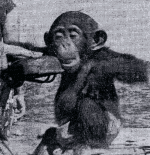 |
Robert Tomarchin’s Moko as he appeared in a New
Zealand newspaper article. Photo by Auckland business man, Harry Gribble, a fellow
passenger on the TEAL flying boat. |
A passenger
on the same TEAL flying-boat in which Robert Tomarchin flew from Apia (Samoa)
to Papeete (Tahiti) reported that the 9 lb chimpanzee was on the aircraft dining
table in front of Tomarchin in a portable cage 1 ft high. The passenger also said
that Tomarchin, a seemingly well-educated American in his late twenties, did not
say where he found the animal or what his purpose was in carrying it about the
Pacific. The chimp Moko was just under 12 months old. Tomarchin claimed
that Moko was the only pure white-skinned chimpanzee in the United States. Even
around Moko's eyes was not to be found the normal dark band found in other chimps.
Tomarchin said that Moko had been born on an experimental farm in East Africa,
but even before his birth Tomarchin had the option to purchase him. Tomarchin
claimed that Moko’s arrival by air in Miami, Florida, as a four-pound bundle,
had caused quite a stir with reporters and photographers vying for a position
from which to take a shot. The Tahiti authorities, it is believed, refused
to allow Tomarchin to exhibit the chimpanzee during the Bastille Day celebrations
in Papeete Tomarchin's profession, if any, is not known. Where the money
he had to pay for his travels came from is not known. Tomarchin met John
and Diane Wells in Papeete. He, and Moko, were onboard the Flying Walrus
when it left Papeete on July 18, four days after the Bastille Day celebrations,
officially bound for Mangareva, Pitcairn, Raivavae, Tubuai and Auckland. Part
1: The Pitcairn Visit of the Flying Walrus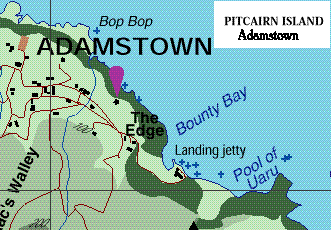 On
the Sabbath morning of August 10, 1957 Morris Warren rang the bell five short
times and the Pitcairn Islanders ran to The Edge. They saw the Canadian yacht
Flying Walrus anchor off Bounty Bay. One of the island's longboats was
launched and went out to meet the yacht. The islanders learned that a Canadian
couple, John Owen Wells and Diane Wells were on board. The Flying Walrus,
they said, had taken ten days to make the three-day trip from Mangareva, due to
a storm. The Flying Walrus had coconuts and mail from Mangareva to deliver
to the Pitcairn Islanders. Diane Wells came ashore and spent the day on the island. On
the Sabbath morning of August 10, 1957 Morris Warren rang the bell five short
times and the Pitcairn Islanders ran to The Edge. They saw the Canadian yacht
Flying Walrus anchor off Bounty Bay. One of the island's longboats was
launched and went out to meet the yacht. The islanders learned that a Canadian
couple, John Owen Wells and Diane Wells were on board. The Flying Walrus,
they said, had taken ten days to make the three-day trip from Mangareva, due to
a storm. The Flying Walrus had coconuts and mail from Mangareva to deliver
to the Pitcairn Islanders. Diane Wells came ashore and spent the day on the island.
Roy
Clark later told the Danish author Arne Falk-Rønne that Diane Wells told the islanders
that she was pregnant and that she and her husband were in a big rush to get to
New Zealand. The islanders asked how she and her husband were able to manage sailing
their yacht alone. She told them that: we had a crewman, but he was unreliable,
and he left us at one of the islands we visited. Another report merely
tells that Mrs. Wells visited the Sabbath School, and heard a farewell hymn, "In
the Sweet By and By," sung for her. She then had a look around the village of
Adamstown and returned to her yacht. The Flying Walrus left again that
evening for Mangareva. Part 2: Sighting on Henderson IslandA month
later, on the the 7th of September, the Shaw Savill cargo liner MS Corinthic,
Capt.(Arthur) Jones in command, arrived at Pitcairn. Parkin Christian got the
news first. Captain Jones of the Corinthic, asked him as soon as he went
aboard if any Pitcairn Island men were on Henderson Island. Corinthic had
passed Henderson on its way from Panama to New Zealand. On being assured that
none were, Capt. Jones notified Parkin that one of his passengers had observed
signals (a sheet or a shirt being waved) being flashed from the North Beach of
the Island. When binoculars were used, a man wearing shorts and what appeared
to be a child, could be seen running along the sand as if to attract attention. Captain
Jones had assumed that he had seen members of a boat crew from Pitcairn visiting
the island. The Pitcairners occasionally visit Henderson Island to cut Miro wood,
which is used to make the curios they sell to passing ships. Later, however, he
gave another explanation in New Zealand of why he did not stop to investigate.
He said that he knew that a scientist was doing some research work on Pitcairn
Island in connection with the International Geophysical Year and thought that
the person he observed was this scientist. Tom Christian confirms that a scientist
named Gene Gillis was on Pitcairn. He set up a Tide gauge and oceanographic recording
station. The station was then handed over to Floyd McCoy for taking daily readings.
"He did not visit Henderson as far as I know." It was a long time
since anyone from Pitcairn had been on Henderson Island. They began to think that
there might be a connection between the crewman from the Flying Walrus
who Mrs. Wells told them had jumped ship on an island, and the figures on Henderson
Island that Capt. Jones told them about. The Pitcairners were worried that
these people were unlikely to be able to find any water on the island, and that
they would die of thirst if they didn't rush to get them away from the island. Before
evening fell, Tom Christian, Radio Officer, sent a radio message from the Pitcairn
Island Radio Station ZBP, to the administration in Fiji, asking for instructions.
On behalf of the Governor of Fiji (Sir Ronald Garvey), who was also Governor of
the Pitcairn Islands group, a message was flashed to Parkin Christian, the Pitcairn
Chief Magistrate, suggesting that the Pitcairners should investigate the matter
further. It was ascertained that no ships were near enough to Henderson to investigate.
Arrangements were made on Pitcairn to send up 2 longboats with volunteer crews.
When an American freighter, the Pioneer Isle, arrived two days later, Tom
Christian called the vessel from the Pitcairn Island Radio Station. He made arrangements
with the Captain to transport the two longboats and their crews onboard the Pioneer
Isle to Henderson Island, in order to discover who the mysterious occupants
were. Sunday morning was all bustle and preparation. The weather was unfavourable,
the responsibility of sending a party accordingly very heavy. The Pitcairn Council
met to deliberate, and while the Council was in session, Tom Christian received
a message from the Pioneer Isle that she would take two boats and their
crews to Henderson at 8 a.m. the following day (Sept. 9). And that is how several
Pitcairn men had their first trip on an ocean-going boat! Part 3: Rescue
Trip to Henderson IslandWhat a trip! The American sailors and officers
of the United States Lines vessel Pioneer Isle were extremely kind, handing
out books and presents of clothing, etc. to the Pitcairn Islanders. The seven
hours' run, filled with exploring the 8,380 tons 439 ft. ship, talking and feeding,
seemed to take no time. When the Pioneer Isle rounded the Northern point
of Henderson Island, just after lunch, a flashing mirror and a white flag on a
mast were observed. There was someone there all right. Now, how were they going
to fit into the speculations of the Pitcairners? Had they been shipwrecked? Did
they have a sick companion? Several men now went ashore in a longboat, led
by Floyd McCoy. Floyd was Navigator and Inspector of Police, as well as a world-famous
radio `ham.' 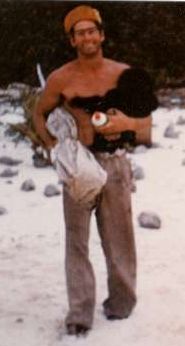 |
Robert Tomarchin and Moko on Henderson Is. (1957) Tom
Christian wrote: The photo is definitely Robert Tomarchin on the beach at
Henderson. Photo supplied by Ron Edwards of Hallam, Victoria, Australia,
who found it during a routine clean up at the Courthouse at Pitcairn in 1980/1
and donated it to the Study Center. |
A young man
came out to meet the longboat. He met them in tears and jumped onboard and hugged
Pervis Young. He told him that he was an American and that the Flying Walrus
had cast him away. Upon the beach was a baby chimp, and "didn't that make our
eyes pop out!" "You have saved my life!" he told them. "There are thousands
of rats, and they have eaten all the supplies I had with me. If you hadn't come
here, I and Moko would have died in a short time." No one was in doubt who
Moko was. A chimpanzee ran screaming of joy back and forth on the beach. The
young man told them that his name was Robert Tomarchin and that he was from Florida,
USA. He told the Pitcairners that he had been on his way back home to the
USA from the Bastille Celebrations on Tahiti. He had taken a job as a crewman
on the Canadian yacht Flying Walrus, with the condition that he could take
his chimpanzee Moko with him onboard too. Unfortunately, it soon turned
out that the chimp was too much for the Captain of the Flying Walrus, and
especially for his nervous wife, Tomarchin claimed. The last straw was when it
ate the wife's vitamins near Henderson. Tomarchin told the Pitcairners that
the Flying Walrus anchored near Henderson and Mr. Wells asked Tomarchin
and Moko to stay on the island for a few days "breathing spell" until Mrs. Wells'
nerves had relaxed. Tomarchin and Moko were given some supplies and were rowed
ashore by Mr. Wells. The next morning Tomarchin looked out to sea and the Flying
Walrus was gone. He knew he was alone on the island now, and that he was left
to his own fate. Tomarchin told the islanders, Thousands
of rats appeared and attacked my camp - eating most of my supplies. I made a bonfire
and that kept them away from the camp. I found some coconuts and some bird's eggs
to eat and spent my time looking for ships on the horizon. No ships were to be
seen, and I became desperate.
Tomarchin claimed that the Wells
family marooned him on the 28th of July, and that he saw his first ship in the
middle of August. This may have been the Rangitiki, which arrived at Pitcairn
on August 26th. He tried to attract the attention of the ship but he didn't know
whether they had seen him. The ship continued on it's course and was soon just
a dot on the horizon. Tomarchin's situation was now critical, as he had eaten
all the bird's eggs he could find, and all the coconuts that were within easy
reach. Tomarchin claimed that he had never heard of Henderson Island before
and that he hadn't consulted any Pilot Manual before leaving the Flying Walrus,
and that he didn't know if there was any water on the island. It was clear
to the Pitcairners who picked him up that he was not telling "quite a straight
story" about his being a castaway from the Flying Walrus. When Tomarchin
was discovered he was found living in a well-stocked tent. Among his provisions:
a sturdy nylon tent, bed, twelve cases of tinned food, radio, case of batteries
to power it, gramophone with metal records, candles, torch cells, a rifle w/ 1,000
rounds of ammunition, fishing rods, 80-pound bow with arrows, cross-bow, underwater
fishing equipment, rubber raft, rubber canoe, a case of seeds of flowers &
vegetables, a case of mixed nails and other supplies. He also had good luggage,
plenty of clothes and a book with plenty of travellers’ cheques. He also
had some chickens and a 44-gallon drum of water. He also had a large galvanised
drum for collecting water and had gone around each morning shaking the dew from
leaves and dipping water our of small hollows in tree branches, etc. All
this equipment was quite a lot for a small yacht the size of the 38 foot Flying
Walrus to leave behind. Tomarchin had raised a mast about 30 feet high that
might have been a mast from a ketch or small boat. Evidently he used
this as signal halyard, as a flag was pulled up and down--a white flag about five
feet by eight feet. Parkin Christian, the Pitcairn Chief Magistrate, later commented
that he could never have found that flag pole on the island. Later speculation
suggested that this might have been the flagpole erected by H.M.S. Leander
in 1937. Tom Christian recently asked Clary Young and Len Brown, who were both
on Pitcairn and in the rescue party to Henderson, about this and they think it
had just been lying on the Island and was found and re-erected by Bob Tomarchin.
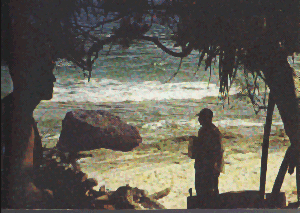 |
| Pitcairn Islanders visit Henderson
Island | A passenger on the Pioneer Isle said
he thought he made out a beach umbrella on the beach. Tomarchin was wearing clothes
somewhat like Robinson Crusoe--scalloped trousers and a funny-cut cap. The Captain
of the Pioneer Isle reported that Tomarchin had apparently shaved very recently
and that he did not want anything from the ship's stores, nor did he want anyone
notified. Tomarchin later told Tom Christian that he was under the impression
that the Pitcairners went to Henderson frequently for wood but after arriving
he saw evidence that they had not been there for some time. The Pitcairners have
always landed on the North or the West beach to cut Miro wood, but it had been
quite some time since the last visit. The North beach is preferred, since it is
approximately 2 miles long, and there is much more wood both Miro, and Tau. Landing
on any of the beaches (North, East or West) can be difficult if there is a large
surf on the reefs. 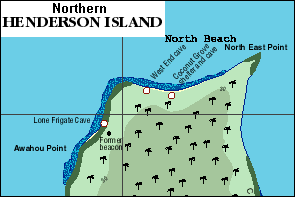 The
Pitcairners set up camp on the shore and begin cutting the Miro wood they need
for the carvings they sell to those on passing ships. The
Pitcairners set up camp on the shore and begin cutting the Miro wood they need
for the carvings they sell to those on passing ships.
There is a certain
place on "their" side of the island where, just at the waterline, a spring of
slightly brackish water runs into the ocean. In an emergency it can be used to
sustain life. However, from the North Beach it is virtually impossible to get
to this marginal water source without going around the island by water. Tomarchin
tried to cut his way through to the opposite side of the island, but the Pitcairners
who came to get him said they couldn't follow his trail, with the clear implication
that it did not penetrate through to the opposite site. There is very, very heavy
growth and bad coral everywhere. Part 4: Return to PitcairnThe
Captain of the Pioneer Isle was willing to take Tomarchin with him to Panama,
but not Moko. Bob refused to be separated from Moko. The Pitcairn Islanders took
pity on the young man and allowed him and Moko to come back with them to their
island in their longboats. That meant going back to the beach, camping the night,
and leaving the next day for home, after taking the opportunity to gather Miro
wood. The 115-mile run back to Pitcairn in the longboats took 23 hours, the weather
had been fair but uncertain at times. On September 10th, the very same day
the Pitcairners were on Henderson Island to "rescue" Tomarchin, the Flying
Walrus radioed to Tom Christian at the Pitcairn Island Radio Station that
Tomarchin had paid them to put him ashore on Henderson Island. The families
on Pitcairn were watching the weather just as anxiously as their loved ones on
Henderson. The wind had swung around until it blew directly from Pitcairn towards
Henderson and had remained there for several days. However, on Henderson, they
noticed that the wind was slowly shifting further to the west, so they set sail
(with Bob and Moko). The quartering wind remained favourable for the entire 115-mile
voyage on a direct course to Pitcairn. The families on Pitcairn were surprised
to see the boats coming in on a direct course, as the wind had never varied from
directly Southwest. There had been no sign of any change, right up to the time
the boats entered the harbour, heading, from their point of view, straight into
the headwind. They were convinced that only the hand of the Lord, whom `even the
winds and the waves obey...' had controlled the elements in their miraculous voyage. Part
5: Tomarchin and Moko on Pitcairn
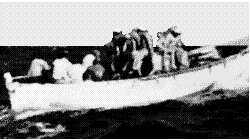 | |
A Pitcairn longboat at sea | Moko's
arrival on Pitcairn was quite an event! At the Landing every eye was on Bob and
his companion. Interested children and grown-ups soon surrounded them. Then, while
the rest of the world wondered on the mystery of Bob, Moko, Henderson Island and
the Flying Walrus, Pitcairn Island settled down to welcoming its guests.
Bob and his chimp stayed with the Chief Magistrate, Parkin Christian. After
a short time Bob Tomarchin was no longer welcome on Pitcairn, at least by those
of more mature years. Bob was a stranger, a very muscular and personable
young man of 27 who had come dramatically onto the island. No wonder the girls
who had only seen their relatives all their lives should be attracted to Bob,
even though he didn't do a tap of work all the time he resided on the island.
The elders of the island could see that Bob was of a different character from
the Pitcairn Islanders. He just did not fit with the ways of Pitcairn. It
appears that The Governor in Fiji also sensed this problem, as a directive arrived
from Fiji instructing that Tomarchin must leave by the next vessel passing Pitcairn.
If arrangements had been made by that time for Moko, then, naturally, Moko would
go too, but if arrangements were not made then Moko should be destroyed. The
Island Council met. It was a directive, and they were happy in one sense as it
relieved them of one problem. The decision would not be theirs. But at the same
time they felt for Bob, after all he had done for Moko. So a compromise was arranged.
Tomarchin must abide by the directive to leave the island by the next vessel.
But Moko could stay on the island for a further period. Bob would be granted 3
months in America during which time he could make arrangements for Moko's medical
clearance papers. When these papers arrived, the Pitcairners would immediately
send Moko over to him. If, however, he failed to make such arrangements during
the 3 months, then Moko became the property of Pitcairn. The islanders could decide
his fate, whether to keep him, destroy him, or to sell him to some zoo which was
able to arrange the necessary papers.
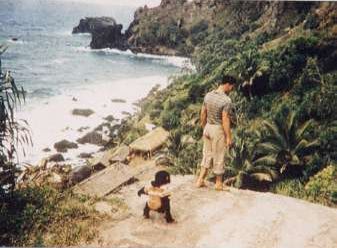 |
| Tomarchin and Moko on
Pitcairn Island (1957) | While
Tomarchin was on Pitcairn the Flying Walrus' was contacted. The authorities
had begun searching for the Wells', when Tomarchin's story about being marooned
on Henderson had become known. At first they could not be located, and fears for
their safety were expressed. and a search intitiated. No one knew quite where
to begin looking for the vessel. It was known that The Flying Walrus had
arrived at Mangareva on August 14 - four days after leaving Pitcairn. Then
one day the Flying Walrus sailed into Rarotonga. Immediately after arriving,
they were apprehended and asked to answer questions as to why they had left a
man to starve on Henderson. They looked blankly at the interrogator until the
import of the question sunk in, then Mr. Wells simply stated, But he paid us
$300 to put him there. (Tom Christian recalls that it was $1000.) It now appears
that Bob had carefully looked over the map and found that Henderson was a good
place from which to stage a publicity stunt. It was large, uninhabited, but was
from time to time visited by a well-known people - the descendants of the Mutiny
on the HMS Bounty. Further, a shipping route passed by, so it would always
be possible to signal a ship if required. The map showed water at a certain point. John
Wells and his wife told the New Zealand Press Association special correspondent
at Rarotonga that Robert Tomarchin was left on Henderson Island at his own request.
They said that Tomarchin, who was training his pet chimpanzee for television appearances
and had supplies for several months, had chartered them to take him to Henderson. Mr.
Wells and his wife said: Tomarchin approached us at Tahiti
with a request to take him and his chimpanzee to Henderson which he had visited
about two years ago. The trip was in fact a charter one paid for by Tomarchin
who took with him sufficient stores to last several months. Tomarchin's intention
was to stay on Henderson until it was visited by Pitcairn Islanders who go to
the island about every three months to collect a certain type of timber. When
the yacht arrived off Henderson conditions were too rough to land and there was
some talk of Tomarchin going on with the yacht to Pitcairn and going back to Henderson
later with Pitcairn Islanders. Tomarchin was against this as he was afraid of
his chimpanzee contracting an illness at Pitcairn.
Wells said
conditions were better on the second day -- August 6 -- and Tomarchin and his
stores were landed safely. The Flying Walrus then went to Pitcairn and
Mangareva before continuing on to Rarotonga. A newspaper interviewed a man
who had met Wells and his wife on Tahiti. When we met them they
had no one by the name of Robert Tomarchin with them. In fact, they never mentioned
picking anyone up in Tahiti or taking on anyone as an extra hand.
Another
person interviewed said: The Wells had no room for a passenger,
but they took Mr. Tomarchin and his animal because they were short of money and
he offered them a high price in dollars. I did not hear where he was bound or
why.He had plenty of dollars
Tom Christian recalls that he
heard at the time that Bob had been told that there was treasure on Henderson
Island and that he was out in search of it. When told about the story told
by John and Diane Wells on Rarotonga, Bob said that he landed at Henderson Island
"for a few days rest for myself and my chimpanzee Moko" as he had
been rather sick during the voyage from Tahiti. He also now claimed that the Flying
Walrus had given him a definite assurance that they would return in four days
to pick him up. He said that the Wells couple intended returning to Canada via
Easter Island and Panama.. Tomarchin's story about the Panama destination
of the Wells couple differs from all other reports. In each port of call, John
Wells and his wife had told of their intention of sailing to New Zealand via Rarotonga. An
interesting question arises: Had Tomarchin been on Pitcairn and Henderson before?
The Wells family reported that he had said he had been on Henderson two years
previously. Parkin Christain, the Pitcairn Magistrate, is also reported as telling
the master of the Pioneer Isle that Tomarchin had been on Pitcairn at some
time in the past. Tom Christian comments that "Tomarchin had definitely not
visited Pitcairn before, and if he did visit Henderson Island previously it must
have been on a visiting yacht." Tom Christian had not heard about Tomarchin
trying to find traces of his parents on Henderson and has no information at all
on any shipwrecks on or near Henderson at the time indicated by Tomarchin. Bob
and Moko lived on the island from 13th September until 26th October, when the
Rangitiki arrived from Wellington, New Zealand, bound for Panama. Bob
was able to arrange passage north on the Rangitiki on October 26. However,
as the Captain refused to take Tomarchin's chimp on the vessel, Moko was left
in the care of Charles and Charlotte Christian. A copy of the October 6,
1957 issue of Pitcairn Pilhi (Vol.2, No. 9) has a scrawled, handwritten note at
the top of the paper: 
Betty
Christian was in her teens at the time, and remembers that Charles and Charlotte
Christian took care of Moko when Tomarchin went back to the States. She remembers
that Moko was always dressed like a little baby or boy and that he would hold
your hand and walk along with you when you were going somewhere. Also she said
that the schoolteacher at the time composed a song about the incident. She does
not remember what happened to the song but is pretty sure that no copy exists
on Pitcairn now. Another source tells that the song `MOKO,' was forwarded to New
Zealand "and may appear on the radio...some day!" Part 6: Pitcairn hadn't
seen the last of Bob TomarchinPitcairn hadn't seen the last of Bob Tomarchin.
Little more than a month later, on November 29, Bob returned to Pitcairn on the
Rangitata. Parkin Christian (the Island magistrate) read a telegram to
the Pitcairners before they left the Landing to visit the Rangitata. Bob
was on board. He had been caught as a stowaway shortly after the ship left Panama,
and, by order of Fiji, the High Commissioner of the United Kingdom, was not to
be permitted to land on Pitcairn. When found as a stowaway in the Rangitata,
Tomarchin was locked in the isolation cabin at the stern of the ship. He was put
to work painting, and favourably impressed passengers as a likeable man. Then
just before the ship reached Pitcairn Island Tomarchin broke free from his cabin
as a meal was being served to him. He was found several hours later among the
lifeboats and according to passengers became almost berserk. Hoses were turned
on him and it took 10 of the crew to subdue him. He was then put back in the isolation
cabin and the door made fast with ropes. The Pitcairners interest in seeing
Bob again was intense, but Bob was locked away in the spare hospital room with
a guard on watch and no one was allowed to see him or send a message. Charles
Christian managed to get fruit to him. As they left the ship Clarence Young yelled
out, Goodbye, Bob! And Bob stuck a hand out of the window and waved pathetically. The
Pitcairners knew that some people would say that Bob was foolish. But, Pitcairn
Islanders, with the lessons of the Bible before them, could wholeheartedly sympathise
with him. In the gracious words of the Pitcairners lovely Lilly (Lilly
Warren - Pitcairn's midwife for many years) : We do not know what his reasons
are and we should not judge him. He must love Moko more than we realise. All Christians
must surely pray that some day soon Moko and his master will be united. The
Rangitata continued on to Auckland with him, and Moko remained on Pitcairn. In
New Zealand, Tomarchin was ordered to pay 98 pounds by a New Zealand magistrate
for stowing away on the Rangitata and for a one-way fare and court costs. The
Australian newspaper the Sydney Truth dated 15.12.1957, contains a photo
of Robert Tomarchin and Moko, and an interview given to them while he was in New
Zealand: Asked if his mission had been a success, he (Tomarchin)
said he would not know until he returned to the U.S. "It might be
another rags-to-riches story, but I will not know until I get back home,"
he said. He said he was writing a book on his adventures and life with Moko. The
book might explain the Henderson Island enigma, he added.
The
same article quotes Tomarchin as saying that he had acquired Moko from a U.S.
animal dealer and that Tomarchin regarded Moko as a genius. "He responds
to commands just to please me." To the Dominion, an Auckland
New Zealand newspaper, he said: I want to get my chimpanzee
back again. I am very attached to Moko. He means everything to me. I don't know
what I shall do next, but I shall keep on trying till I get him back.
A
report from passengers on the Rangitata that Tomarchin had said he went
to Henderson Island to try to find traces of his parents, who were shipwrecked
there 20 years ago, was denied. "Why did you go to Henderson Island,
then?" he was asked. "I can't tell you that," Tomarchin
replied. This is the first, and only, time we hear about the shipwrecked
parents. Was this just tall tales he told the passengers as he had contact with
them on shipboard? Just as the story he told Tom Christian about treasure on Henderson
Island, it seems Tomarchin often told stories to catch the attention of the people
around him. With his beserk behaviour on board the Rangitata, and many
of the other things he did, one wonders about Tomarchin's sanity. The Auckland
Herald published a story about him that made a slip or two in factual accuracy.
Tomarchin sued them, got 300 pounds, paid off his stowaway debt and made his way
back to Pitcairn on the Rangitiki. The Rangitata and the Rangitiki
were both ships of the New Zealand Shipping Company (NZSC), which regularly
called at Pitcairn both outbound (from England) and homebound (to England). Captains
of all NZSC and Shaw Savill ships were ordered by their companies to call
at Pitcairn primarily to give passengers a break during the long Pacific voyage,
but also to give the Pitcairners a trading-sales opportunity for their curios. When
the Rangitiki arrived at Pitcairn a few weeks later, Bob was onboard -
this time as a paying passenger. Before the ship sailed, Moko was returned to
its owner, and the man and his chimpanzee sailed into the sunrise. It appears
that Charles Christian wasn't very concerned about losing the responsibility of
caring for Moko. He liked Moko, but not in the way Bob liked him, quite obviously. Tom
Christian recalls that Tomarchin did correspond with someone on Pitcairn for a
while but then dropped out of sight. Part 7: Tomarchin's return to the
US(The following “rest of the story” information” is taken from “Mr. Moke the Talking Chimpanzee,” by Peter Dickinson, at http://hubpages.com/hub/Mr-Moke-the-Talking-Chimpanzee.)
Reunited, the pair headed back to the USA where they worked the circuits and appeared several times on TV for a few years. Business was good but not quite good enough and Robert was drawn by a ‘business deal’ which he reckoned would take him away to Tahiti for about a year. What the deal was is not recorded and whether it involved another trip to Henderson Island will remain a mystery.
So Moko was sole for $1,575 to the St. Louis Zoo by his owner, the 27-year-old Robert Tomarchin. Robert was worried about handing Moko on to just anybody whilst he was away and figured that the zoo would be the best place to are for him. The zoo had something of a reputation and had been presenting a Chimpanzee Show since 1925. The zoo renamed Moko and called him Mr. Moke.
On his return, Robert was of the opinion that Moko was heart broken and requested that the zoo sell him back. Robert described his relationship with the animal to be that of ‘father and son.’ By this time the animal was popular with zoo staff and visitors alike and so they refused. On the dark night of December 21st 1959, Robert sneaked into the zoo and stole back Moko. It was not as if Robert wanted to steal him because he was obviously very attached and so he left in the animal’s place a cheque for $1,000 and an IOU for $2,000. In effect he was nearly doubling the money he had received from the zoo when he first sold him. Robert did not feel so much that he had stolen Mr. Moke so much as bought him back.
The missing animal naturally made headlines and the story even appeared in Life Magazine. Robert and Moko allegedly headed for Mexico. During this missing period Mr. Moke appeared in the Jerry Lewis movie ‘The Bell Boy’ which must have earned Robert a bit of money.
Mr. Moke and Robert were eventually caught in Florida. In that state they sought sanctuary, and requested that the governor of Florida speak out on their behalf. Sadly, they got little sympathy. The lawyer for Robert Tomarchin tried to argue the case by comparing it to the separation from a parent of a human child. It was suggested that the relationship between Robert and Moko was that of ‘Father and Son,’ and this may well have been the case in reality. In this instance Robert’s lawyer, John B. Orr of Miami, compared the situation to the ‘Hildy Ellis’ case where the law was bent to suit the situation.
(Hildy Ellis was a Catholic child adopted by a Jewish couple. The case was so controversial it was frequently in the press for several years.)
Attorney Orr also put forward the argument that there was no law in Missouri about stealing a chimpanzee, and it was not against the common law in Missouri to steal an inedible animal.
No one could deny that the lawyer made supreme efforts on behalf of his client, but, sadly, the defense failed, and Mr. Moke was boxed up and flown back to the St. Louis Zoo in 1961. The unfortunate Robert was sentenced by a jury to four years in prison.
The little chimpanzee continued to perform in the zoo until 1965 when he was ten years old. A ten-year-old chimpanzee is no longer small. Big, strong and unpredictable, he was sensibly retired from performances. He died in the early 1970s after an illustrious career which included another escape. This time, though, he was alone, and had to be sedated with a tranquilizer dart as he had bitten the zoo train driver during his escape.
Robert Tomarchin ended his days as a dog trainer on the Gold Coast of Australia. Many of his does he called Moko or Mr. Moke.
Robert died on June 18, 1995. He is buried in Allambe Memorial Park near Nerang, Australia.
If anyone passes that way please put a flower on his grave for me. Robert was definitely an odd character, but I do believe he really loved that little chimpanzee.
Part 8: The Pitcairn Islanders mentioned in
this narrative
| Betty: Betty Jean Christian
(1943- ) living on Pitcairn | | Charles: Charles Bert Christian
(1931- ) living on Pitcairn | | Charlotte: Charlotte Zita
Warren (1928-1996) | | Clarence: Clarence Robert Young
(1925- ) now living in New Zealand | | Floyd: Floyd Hastings
McCoy (1897-1963) | | Lovely Lilly: Alice Lily Butler (1878-1969),
wife of George Francis Warren | | Morris Warren: Morris
Sterling Warren (1906-1984) | | Parkin Christian: Charles
Richard Parkin Christian (1883-1971) | | Pervis: Pervis
Ferris Young (1928- ) living in Auckland, New Zealand. |
| Roy Clark: Roy Palmer Clark (1893-1980) | | Tom:
Thomas Coleman Christian (1935- ) living on Pitcairn | This
list of Pitcairn Islanders was compiled by Paul J. Lareau NoticeThe
information above has been checked for accuracy and approved by Tom Christian
from Pitcairn. The information provided on this page by Dr. Herbert Ford is Copyright
(c) Dr. Herbert Ford of the Pitcairn Islands Study Center. Further information,
including interviews of Tom and Betty Christian on Pitcairn, was provided by Howard
L Phelps and is Copyright (c) Howard L. Phelps. This narrative collation page
of material from many sources (letters, interviews and other unpublished sources,
the Pitcairn newsletter and contemporary newspaper articles) is Copyright (c)
Mark Winthrop and used by permission. Some information on this page is based upon
translated excerpts from Paradis om bagbord (Paradise on the port side) 1977 by
Arne Falk-Rønne.The original book is in the Danish language, and it is not known
whether it has been translated to other languages. --Text by Mark Winthrop
of Copenhagen, Denmark. Used by permission. (http://www.winthrop.dk/chimp.html)[The
Skeletons] [Henderson Island] |